This post was developed by i2 as an advertorial for the Spring 2011 edition of RUSI’s (The Royal United Services Institute) Defence Systems.
In 2003, Saddam Hussein was on the run. With his chain of command eliminated, traditional intelligence efforts to track him down were failing. Col. James Hickey, U.S. Army, heading the intelligence operation to find Saddam, determined that the reclusive Iraqi dictator only trusted and communicated with family members of his own tribal group. As Hickey said, “We built a fairly elaborate estimate of who Saddam’s supporters were in the area; though it did provide security, it also worked against them. Once we learnt who did what, it allowed us to work against them.”1
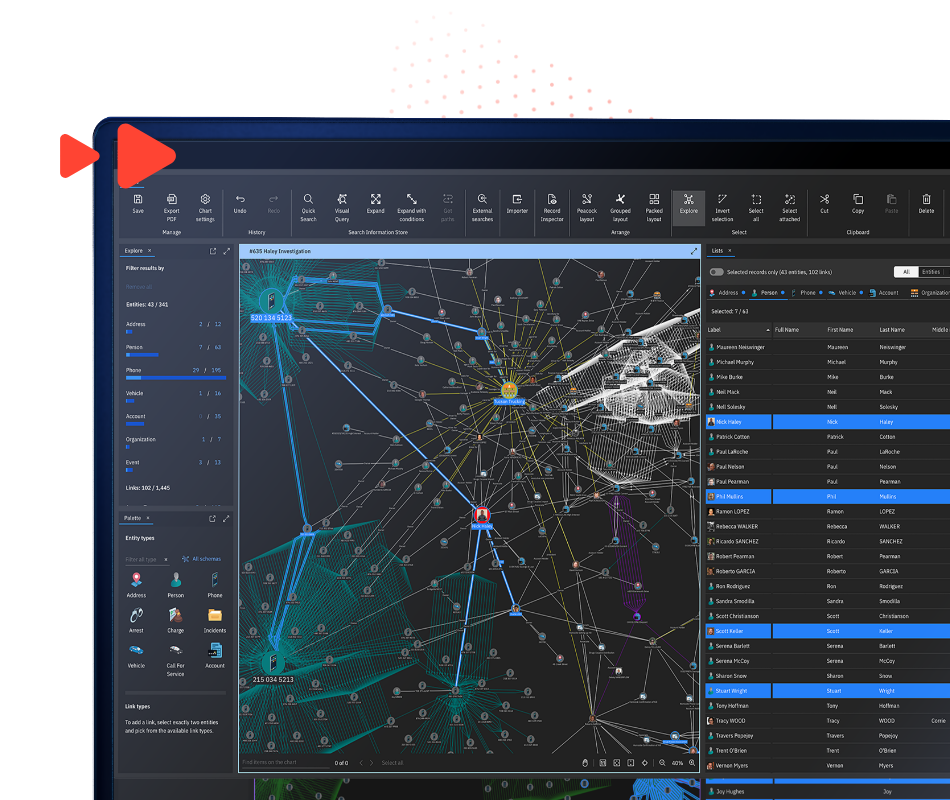
Hickey and his team were using a nascent form of Social Network Analysis (SNA). In its purest form, SNA relies on examining the linkages between people and places within a defined group or locality in order to deduce the key decision makers or vulnerable links and where they are located. In this case, it was the pinpointing of Saddam’s chauffeurs that led to his historic capture.

Figure 1
READ MORE 
Robert Griffin Joins Board for Three-Year Term
The Intelligence and National Security Alliance (INSA) today named i2 CEO Robert Griffin to its Board of Directors. Griffin joins industry and government leaders from Booz Allen Hamilton, CACI, Lockheed Martin, ManTech, Microsoft, QinetiQ North America, Raytheon Intelligence and Information Systems, SAIC and the Office of the Director of National Intelligence. In this role, he will work with the Board to help drive INSA’s agenda across the Intelligence and National Security Communities.
READ MORE 
General Keith Alexander, the new Cyber Command Chief, recently stated that his current mandate is to protect against cyber threats to the Department of Defense. However, current law does not dictate how to protect critical infrastructure managed and/or used by the private sector. In testimony on Capitol Hill last week, Gen. Alexander essentially supported the notion that this planning cannot be done in a vacuum, but with the full input and support from private industry.
“We cannot do it without industry support, and industry can’t do it without our support,” he said. “But by the time a company reaches out to DHS after an attack, the damage is already done.”
READ MORE 
To be sure, American businesses are just as big a target and are exposed to just as severe a degree of cyber threats as U.S. government agencies. They also display just as varied levels of preparedness to defend themselves. Whose responsibility is it, when you consider that many businesses are considered “critical infrastructure” — such as defense contractors, financial, telecommunications, power and transportation companies – and are integral to national security? READ MORE 
It seems that not a day goes by without someone talking about cyber and the crimes related to the stealing of data, personal information, classified information and the tremendous financial and national security implications worldwide. To deal with this threat effectively, i2 is working with multiple organizations to assist with marshaling resources, developing policy, providing technology solutions and building partnerships to combat cyber exploitation. READ MORE 

Mapping of complex hacker networks
For too long hackers have felt secure hiding behind the disconnect between the real-world and cyber world. Using BotNets, hackers have too easily been able to conceal their identities. Or they were, before i2’s Cyber solution provided a way to bridge that gap. In a new case study about cyber risks, i2 looks at how Dr. Craig Valli and his research students at the Edith Cowan University School of Computer Security and Forensics used our Cyber solution to identify and isolate hackers. READ MORE 
Computer hackers are no longer viewed as outsiders living in their parents’ basements — occasionally dangerous, but usually more of an annoyance to government cyber security professionals. In fact, the governments of the U.S. and the United Kingdom are actively recruiting them as their newest weapon to answer their malicious counterparts who are members of organized crime rings and hostile nation-state cyber armies. The U.S announced this year its first-ever “Cyber Challenge,” a nationwide contest which mirrors a similar competition China has been running for five years. Organizers say the Cyber Challenge is designed to identify young people with exceptional computer skills and inspire them to join the shorthanded ranks of specialists needed to protect government, military and industrial cyber infrastructure. READ MORE 
Latest Comments